Technical Insights
The Fastest Way to Verify ALPM Mode in Embedded DisplayPort Designs
 5 min
5 min
3 min





VESA’s DisplayPort is a versatile and modern video interface standard for transmitting high quality image streams. Its use is already widespread among consumer electronic products and is increasingly becoming the preferred choice for display manufacturers. DisplayPort supports high resolutions and refresh rates, high dynamic range (HDR), and has the unique ability to transmit multiple streams from a single source. The most recent version of DisplayPort (v2.1) offers significantly increased bandwidth and transmit data at rates of 80 Gbps.
Link training is one of the key parts of the DisplayPort specification. Simply put, it is a provision that ensures that the sink and source devices negotiate and agree upon key parameters needed to communicate at the start of their interaction. This entails establishing things like the data transfer rate, the number of lanes to be used, voltage-swing and pre-emphasis levels.
Any commercially available device is expected to be able to link train according to the standard. However, during early design stages, it is possible the prototype being built doesn’t have link training capabilities set up. Design engineers would still need to be able to communicate to the prototype using a DisplayPort stream for validation purposes. In most cases however, engineers would hit a roadblock as this capability is not present in most testers.
This is where Introspect’s SV7C-eDP Embedded DisplayPort Generator comes in. One of the unique features of this product is that it is able to send a DisplayPort data stream, even if the sink device doesn’t support link training yet. The Pinetree software has an option which disables the link training on the sstGenerator component, as seen in Figure 1 below.
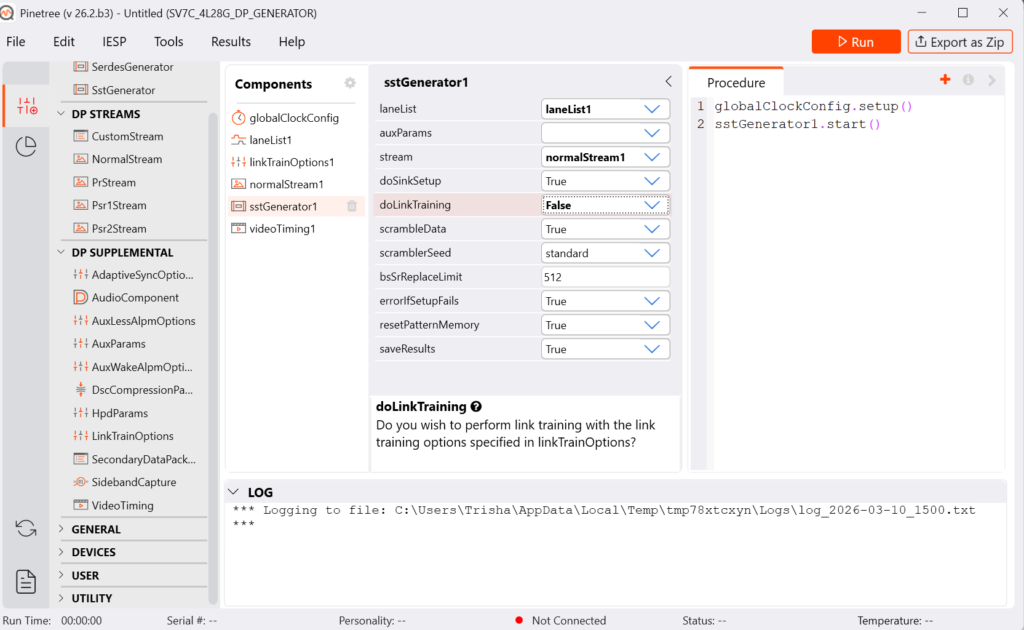 Figure 1: The sstGenerator component in the Pinetree software allows test engineers to disable the link training option on the device and send a DisplayPort stream.
With the simple press of a button, Introspect allows test engineers to carry out a critical assessment which would not have been possible otherwise. By sending a display stream to the prototype in early design stages, engineers can validate traffic on the main link receivers, check for protocol violations, and ensure that signal integrity on their system is sound.
Working on a DisplayPort project? Our team at Introspect Technology is ready to help. Reach out at info@introspect.ca to discuss your design challenges and discover how our tools can make seamless validation.